San Francisco, CA / Syndication Cloud / January 8, 2026 / Lift AI
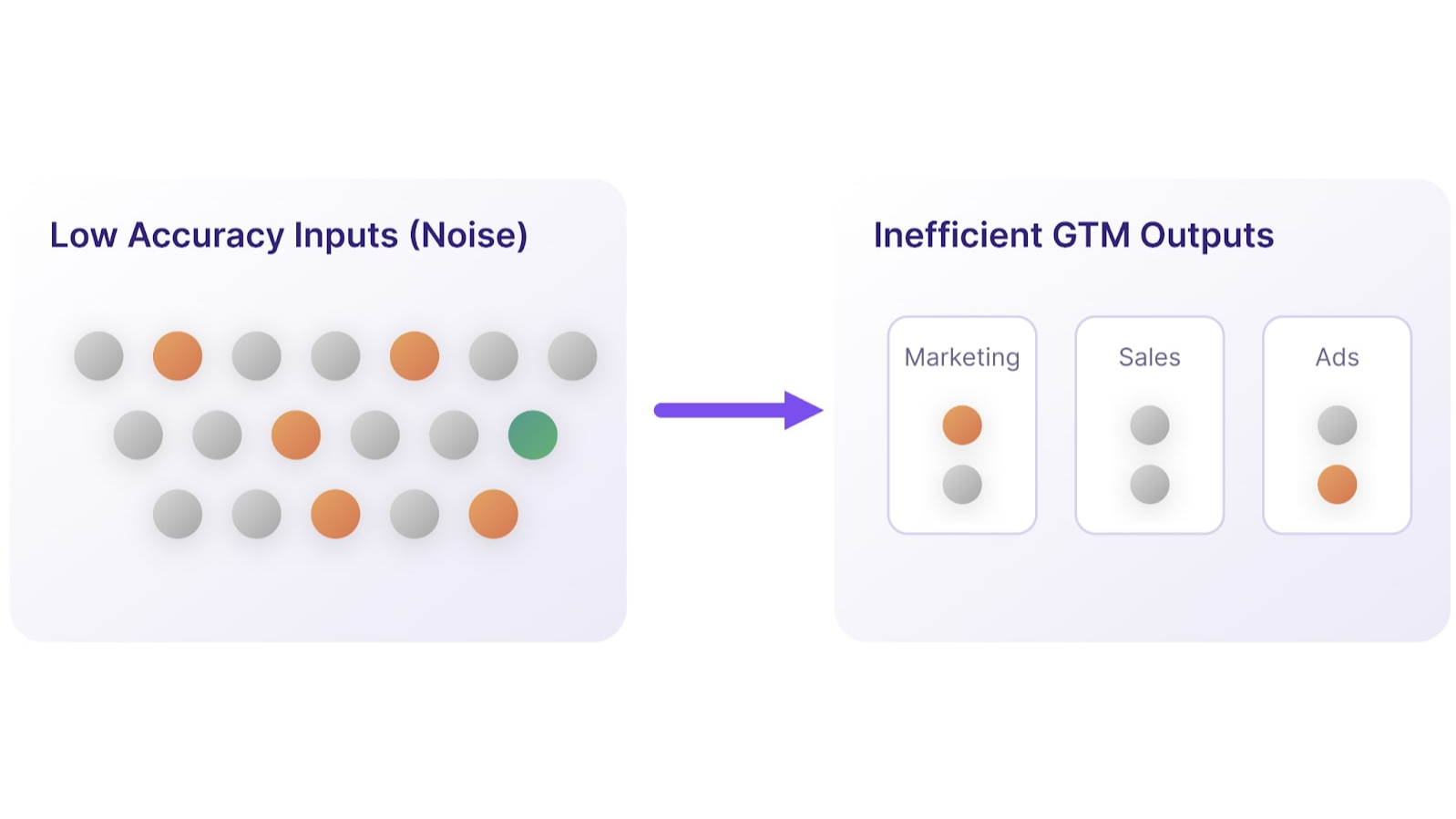
That reality is now showing up clearly in the data. According to MIT’s State of AI in Business 2025 report, 95% of enterprise AI pilots fail to deliver measurable business impact. And Fortune magazine’s analysis of enterprise AI failures points to the same conclusion: most initiatives don’t fail because AI models are weak or ambition is misplaced – but because the underlying data feeding these systems lacks the accuracy required to perform at scale.
The #1 Reason AI Pilots Fail: Poor Data Quality
When data is inconsistent, incomplete or inaccurate, even the most advanced tools struggle to produce meaningful outputs. This is especially true across enterprise GTM systems, where data determines everything from sales prioritization to routing, lead scoring, personalized messaging, retargeting campaigns, conversion attribution and revenue forecasting.
When data input signals are wrong, it creates friction from the very first interaction. As the Fortune report notes, AI projects live — and die — on the quality of data. Yet many GTM teams still depend on outdated or weak intent data — and the accuracy gap is far wider than most realize.
The Intent Data Accuracy Gap Is Breaking GTM Engines
Intent data has become the backbone of modern GTM strategy. Yet traditional signals — page views, form fills, email engagement and third-party intent segments — typically deliver at less than 20% accuracy.
When inaccurate signals are used to guide conversational AI, sales routing, messaging, ad targeting and personalization – GTM systems become misaligned at the source and generate friction all throughout the funnel. Sales teams chase low-intent leads, AI agents communicate using wrong assumptions, marketing budgets are misallocated, pipeline forecasts lose reliability and attribution becomes increasingly unclear.
Simply put, inaccurate intent data pollutes every downstream GTM action. Until data accuracy improves, AI-driven tools cannot deliver the sustainable GTM growth they promise — because increasing activity without better data does not increase conversions.
Your Website Already Knows Who’s Ready to Buy
While many companies rely on third-party intent providers, the most powerful insights into buyer readiness already exist inside the enterprise — within website visitor behavior.
Every scroll, click, pause, dwell-time pattern, and micro-interaction reflects where a visitor is in their buying journey. Yet most GTM teams lack the ability to interpret these signals at scale or with meaningful accuracy, leaving one of the richest sources of buyer intent underutilized.
This gap has created the need for a new approach to website visitor buyer intent detection.
A Shift Toward Accurate First-Party Behavioral Intent
A new category of behavioral intent technology has emerged, focused on extracting intent directly from micro-behavioral first-party website behavior rather than relying on simple page views, form fills, or third-party surface-level proxies.
Companies such as Lift AI are helping define this shift through Micro-Behavioral Analysis, an AI-driven Machine Learning approach trained on billions of website sessions and millions of conversions. By evaluating hundreds of behavioral attributes per visitor, this method has demonstrated accuracy levels exceeding 85% in predicting true buyer intent and segmenting every website visitor into low, mid and high-intent audiences.
To validate performance, Lift AI introduced a Buyer Intent Accuracy Dashboard that measures how predicted intent correlates with real website conversion outcomes. This level of visibility into buyer intent data accuracy — validated against actual sales conversions — is unique within the category.
As AI agents take on greater responsibility across GTM workflows, accurate first-party buyer intent signals are moving from a competitive advantage to a foundational requirement.
Better Data, Better AI, Better GTM Outcomes
MIT’s findings reinforce a critical conclusion: AI is not failing — GTM data is. Organizations that succeed with AI build their go-to-market engines on reliable, validated, high-quality data. Those that don’t continue to experience stalled pilots and disappointing outcomes.
The GTM data input problem is simple but devastating. When the accuracy of the data fueling your GTM engine can’t be trusted, every downstream motion — including sales prioritization, conversational AI, chat bots, marketing messages and retargeting campaigns — is compromised before execution even begins.
For GTM leaders, the implications are clear:
- Prioritization improves when data accuracy is high
- AI agents perform better when signals are trustworthy
- Sales teams convert more by focusing on buyers who are truly ready
- Marketing spend becomes significantly more efficient
- Revenue forecasting gains clarity and confidence
As AI becomes fully embedded across GTM operations, data accuracy is no longer a technical consideration — it is a competitive mandate. The organizations that solve the GTM data accuracy problem will be the ones that unlock the full potential of rapid and sustainable AI-driven growth.
Lift AI
dsimpson@lift-ai.com
One Sansome Street
Suite 3500
San Francisco
CA
94104
United States